
Congratulations to Brian P. Murphy and Richard E. Cannon of the University of Edinburgh, recipients of the 2026 Schweickart Prize for their winning proposal, Untold Threats: A Worldwide Call to Defend New Frontiers.
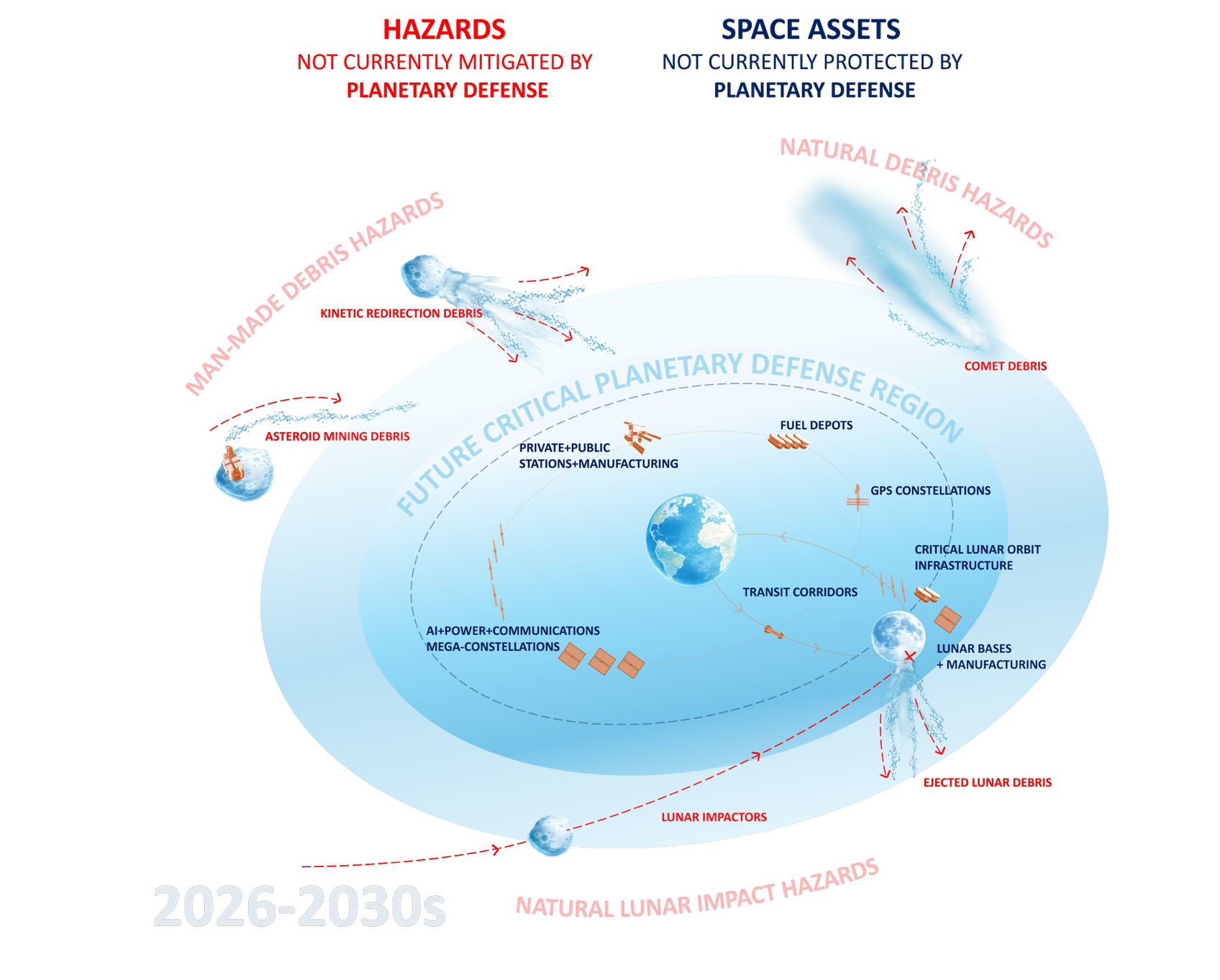
Their work highlights emerging threats posed by meteoroid storms, asteroid ejecta, lunar impacts, and other hazards that could jeopardize the rapidly expanding ecosystem of satellites, communications systems, lunar infrastructure, and future space-based industries. The urgency is underscored by the authors' warning that dense meteoroid storms are projected to return between 2028 and 2034, at a time when the total cross-sectional area of assets in orbit may be hundreds of times greater than during the last major storm in 1993.
Download the full proposal
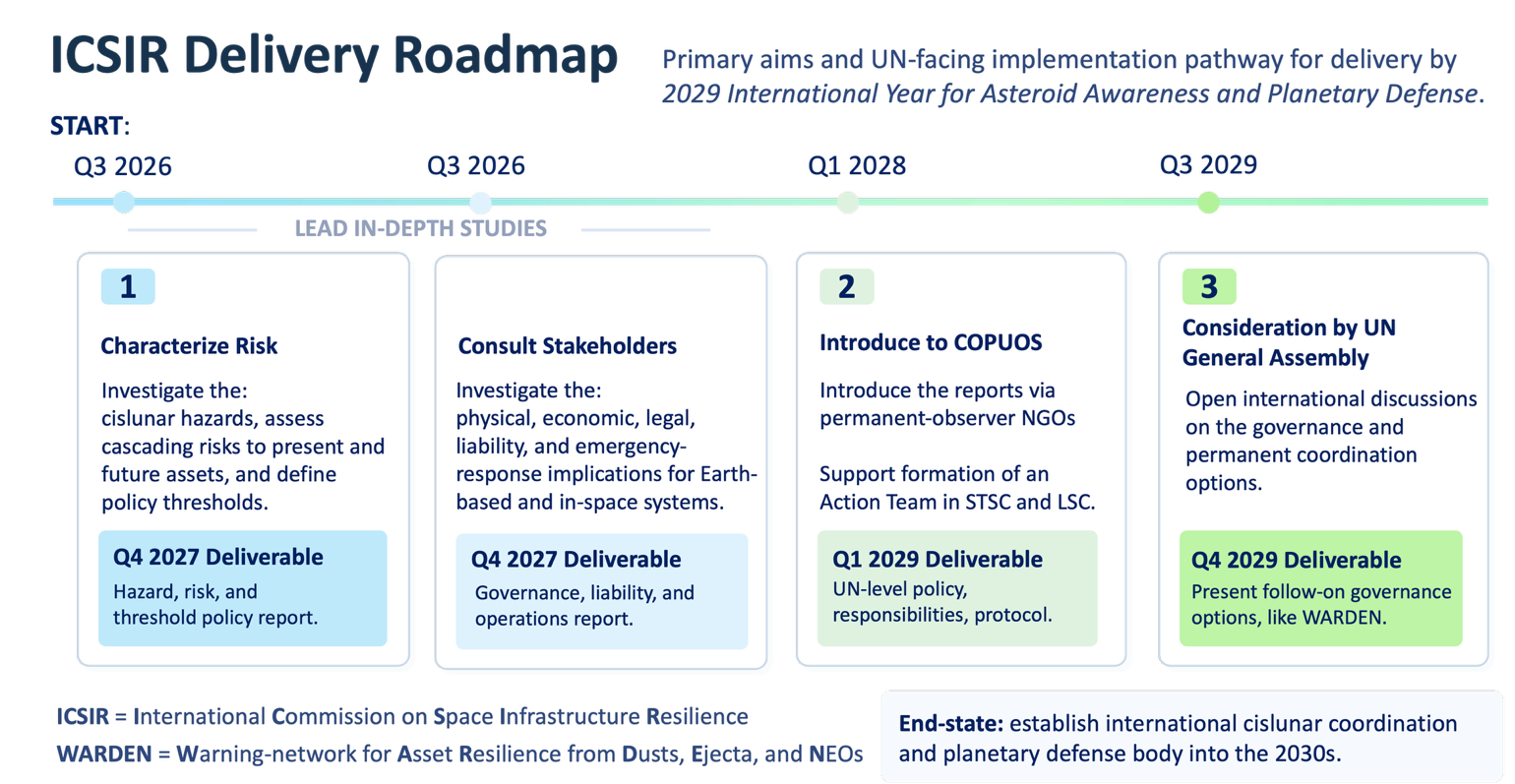
Their central recommendation is the immediate formation of an International Commission on Space Infrastructure Resilience (ICSIR), an independent body tasked with investigating the growing risks to infrastructure throughout the Earth-Moon system. The authors envision a phased roadmap beginning with scientific, legal, economic, and operational studies, followed by engagement with international stakeholders and the United Nations Committee on the Peaceful Uses of Outer Space (COPUOS) — with ICSIR reports targeted for delivery before the Perseid storm returns in 2028.
Ultimately, they propose the establishment of a permanent international coordinating body, termed WARDEN (Warning-network for Asset Resilience from Dusts, Ejecta, and NEOs), to complement existing organizations such as the International Asteroid Warning Network (IAWN) and the Space Mission Planning Advisory Group (SMPAG). Together, these organizations would help coordinate the protection of humanity's assets throughout cislunar space and ensure that planetary defense evolves alongside humanity's expansion beyond Earth.
The proposal builds upon the precedent established by the Association of Space Explorers and the international efforts that ultimately led to the creation of IAWN and SMPAG. In many ways, the authors argue, the next chapter of planetary defense should follow a similar path: one grounded in international cooperation, long-term stewardship, and the recognition that protecting civilization increasingly means protecting the infrastructure that supports it beyond Earth.
Download the full proposal